
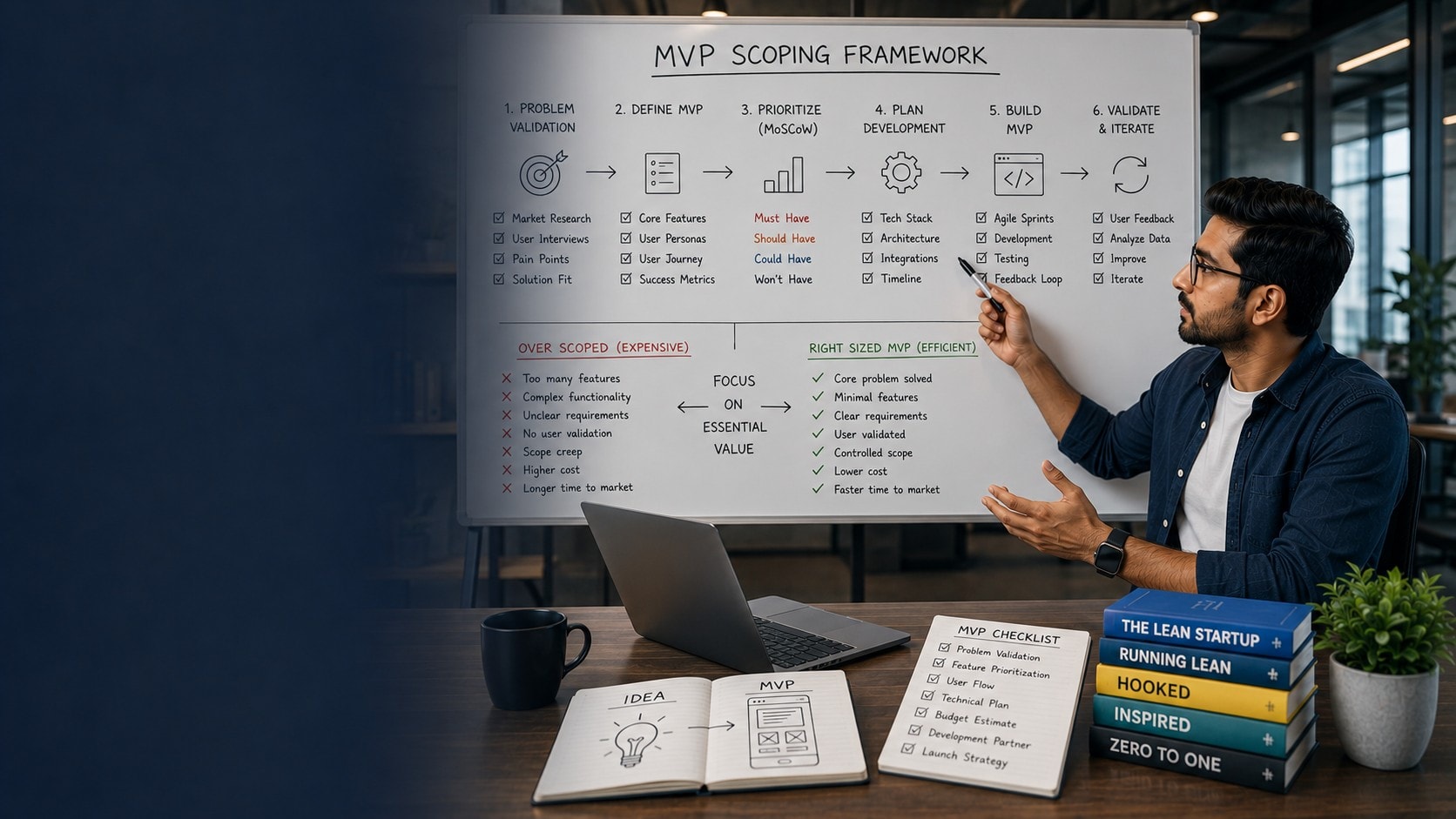
Most startups do not overspend because software development is expensive. They overspend because the MVP scope is too big. A founder starts with a simple idea. Then one more feature gets added, then a dashboard, an admin panel, payments, AI, reports, a mobile app, and integrations. The "lean MVP" becomes a full product build. Budgets stretch, timelines slip, and the founder loses control of the process.
The real skill is not only knowing how to build an MVP. It is knowing how to scope it before development starts. This guide explains what correct scoping means, a step-by-step method, how to prioritise features, how to control feature creep, and how to keep scope under control after the build begins.
What does it mean to scope an MVP correctly?
Scoping an MVP means defining the smallest useful version of your product that can test a real market assumption. It includes only the features needed to solve one important user problem, deliver early value, collect feedback, and guide your next decision. A correctly scoped MVP is not the cheapest product possible. It is the clearest one. It helps you answer four questions:
- Does this problem matter?
- Will users engage with this solution?
- Which features are actually necessary?
- Can this become a scalable business?
When scope is unclear, every feature feels important. When scope is clear, you can separate what is essential from what is merely exciting.
Why startups overspend on MVP development
Startups often mistake useful features for necessary ones. A feature can be useful and still not belong in version one. A SaaS product may eventually need advanced analytics, role-based permissions, billing automation, AI insights, mobile apps, and integrations. If the first goal is to test whether users want the core workflow, most of those can wait.
Common causes of overspending:
- Unclear requirements.
- Too many target users.
- No way to prioritise features.
- Fear of launching "too small".
- Priorities that change during development.
- Building to impress investors instead of serving users.
- Choosing technology before defining the business problem.
The most expensive MVP is not always the one with the highest quote. It is the one that teaches you too little after launch.
The mistake: treating the MVP as version one of the final product
Many founders think an MVP is the first version of the finished product. That mindset creates scope creep. A better view: an MVP is the smallest experiment that can test a business assumption. Instead of asking "What features should the product eventually have?", ask "What do we need to build first to prove the next important assumption?" That question protects your budget, timeline, and focus. For the bigger picture, see the power of an MVP.
A practical framework for scoping an MVP
Evaluate every feature against one question: will this feature directly help us test our main business hypothesis? If not, it probably does not belong in the first release.
Step 1: Define one core problem
Do not try to solve five problems at once. The strongest products solve one meaningful problem very well. "We want an all-in-one business platform" is too broad. "We help freelance designers manage client invoices in under five minutes" is focused. A narrow focus removes unnecessary functionality by itself. If you are not sure the problem is real, start with how to validate a startup idea before building an MVP.
Step 2: Choose one success metric
Before discussing screens, define what success looks like: the first 100 sign-ups, the first paid customer, weekly active users, completed bookings, projects created, or retention after 30 days. Every feature should help move that number.
Step 3: Map the core user journey
Write the shortest path from sign-up to value. Include the easily missed steps: account recovery, invitations, permissions, and error handling. Only features on that path are candidates for the MVP.
Step 4: Prioritise with MoSCoW
Sort every feature into one group:
- Must have: essential for launch.
- Should have: valuable but not required.
- Could have: nice for future releases.
- Won’t have (yet): deliberately postponed.
Many founders find that a large share of their planned features fall into "could have" once they do this honestly.
Step 5: Score what is left
For the remaining candidates, compare customer value, learning value, and effort. A simple table works:
| Feature | Customer value | Learning value | Effort | Decision |
|---|---|---|---|---|
| Core task workflow | High | High | Medium | Include |
| Basic sign-in | Medium | Medium | Low | Include |
| Custom themes | Low | Low | Medium | Delay |
| Advanced analytics | Medium | Low early on | High | Delay or deliver manually |
| Automated notifications | Medium | Low | Medium | Handle manually at first |
Step 6: Write an out-of-scope list
List what you will not build, such as secondary user roles, extra integrations, mobile apps, advanced reports, and custom branding. This protects the plan from slow expansion and gives you a calm answer when someone asks for a feature: "It is on the later list. Here is the evidence we need to bring it forward."
Questions to ask before approving any feature
- Does it solve the primary customer problem?
- Will users fail to get value without it?
- Can we do this manually at first?
- Does it produce meaningful learning?
- Will customers pay because of it?
- Can it wait until version 2?
- Is it needed for security, legal, or safe operation?
If several answers say it can wait, remove it from the MVP. Features that are not needed for value, learning, or safe operation usually do not belong in the first release. Manual work behind the scenes is acceptable early on, as long as users still get the outcome and you track the effort so you know when to automate.
How feature creep destroys budgets
Feature creep rarely starts with a bad decision. It builds through small, reasonable requests: "Let’s add notifications." "Can we include dashboards?" "Users might need analytics later." "Let’s prepare for enterprise customers." "We’ll probably need AI recommendations." Each one looks small. Together they can turn a short MVP into a long project, and each change can also mean more design, testing, and rework of finished work.
Two scopes for the same idea (illustrative)
This is a made-up example, not a client case. Two founders plan a property management product.
- Founder A lists tenant management, maintenance requests, accounting, an AI chatbot, vendor management, reporting, payments, mobile apps, owner dashboards, and a CRM. The plan is large, the timeline is long, and nothing is tested until the end.
- Founder B asks, "What is the smallest product landlords would pay for?" The MVP is property listing, tenant records, maintenance tickets, and email notifications. It launches sooner, and customer feedback decides what gets built next.
The second founder spends less, launches earlier, and starts learning from real customers sooner.
How to keep scope under control during the build
- Agree the scope and the out-of-scope list before development starts.
- Document product decisions and why they were made.
- Name one person who owns scope decisions. Many opinions cause drift.
- Review change requests at set times, for example weekly, not immediately.
- Require a trade-off for every addition: replace something, extend the timeline, increase the budget, or move it to a later release.
- Separate feedback from commitments. One customer’s request may be a personal preference. Repeated requests across your target segment may be a real need.
- Delay optimisation until customer validation exists.
Investing a few days in scoping often saves months of development later. See product discovery before MVP costs for how to run that planning.
Why a smaller MVP usually wins
A focused MVP often gives a better user experience, faster feedback, and earlier paying customers. A lean product lets you:
- Launch earlier.
- Reduce initial development cost.
- Test real demand quickly.
- Collect useful user feedback.
- Prioritise later features using real data.
- Show investors evidence rather than plans.
The best signal that your scope is right is that every feature has a clear purpose and supports one validation goal.
What should happen after launch?
Launch is the start of learning, not the finish. Instead of planning version 2 immediately, watch how people use the product. Track sign-ups, activation, retention, feature usage, conversion, and feedback. Real users will show which requests repeat and which assumptions were wrong. Build the next features from that evidence, not from internal opinion. Read the post-MVP roadmap and SaaS feature prioritisation after MVP.
Frequently asked questions
What is MVP scoping?
Identifying the minimum set of features needed to test a product idea with real users while limiting time, cost, and risk.
Why do startups overspend on MVP development?
They include too many features before validating demand. Poor planning, changing requirements, and feature creep drive up cost.
How many features should an MVP include?
Only those needed to solve one core customer problem and test your main hypothesis. There is no fixed number.
How long should MVP planning take?
It depends on complexity. Many teams spend one to four weeks on validation, requirements, prioritisation, and technical planning, but a simple product may need less and a complex one more.
What is feature creep?
Continuously adding functionality during development, which increases complexity, cost, and timeline without improving your validation goals.
Should startups build every planned feature before launch?
No. Launch with the essentials, collect feedback, and improve based on real use.
How do I prioritise MVP features?
Use MoSCoW, customer interviews, and a simple score of customer value, learning value, and effort. Keep an out-of-scope list.
Can non-technical founders scope an MVP?
Yes. Focus on the customer problem and the user journey, validate the idea, and work closely with an experienced product team.
When should startups add advanced features?
After customer evidence confirms demand and early metrics justify the investment.
Final thoughts
The most successful startups are not the ones that launch with the largest products. They are the ones that learn fastest. Scoping an MVP correctly means deciding what to build now and what can wait, so that every feature has a purpose, supports your validation goal, and helps solve one meaningful customer problem. For the full process, read how to build an MVP in 2026.
To define your MVP scope with our team, see our SaaS MVP development service or book a call with Ksoft Technologies.